Home & Comfort · Research Article
Pillows for Side, Back and Stomach Sleepers: What to Compare
Position is the first filter in any pillow decision — it changes the loft, the firmness and often the shape you should be shortlisting.
Quick Takeaway
Sleeping position determines how much space a pillow has to fill. Side sleeping leaves the largest gap and generally calls for higher, firmer support; back sleeping leaves a smaller gap and suits medium loft; stomach sleeping leaves almost none and suits very low, soft pillows.
Many people change position during the night. For them the useful comparison is not a single ideal loft but whether the pillow is adjustable, contoured or wide enough to stay workable across positions.
Product pages are usually organised by material — foam, down, latex, fibre — but material is the second question. The first is the position you actually sleep in, because that determines the geometry the pillow has to solve.
This article goes through each position, what changes about the pillow requirement, and what to compare when your position varies through the night.
Why Sleeping Position Comes First
A pillow's job is to fill the space between your head and the mattress so your head is not propped up or left hanging. That space is entirely determined by how you lie: on your side it is roughly a shoulder width, on your back it is the much smaller gap behind your head, and face down it is barely anything at all.
Because the gap is different in each case, so is the loft, and often the firmness and shape too. Material affects how a pillow feels, but it cannot correct a pillow that is the wrong height for the position you sleep in.
Pillows for Side Sleepers
Side sleeping leaves the largest gap of the three positions, so it generally needs the most loft. It also benefits from firmer support, because a soft pillow compresses under the weight of the head and the effective height ends up lower than the stated one.
Width matters more here than people expect. Side sleepers often tuck an arm under or in front of the pillow, and many shift slightly through the night, so a pillow that is too narrow runs out of usable surface. Gusseted pillows — with a fabric panel around the edge that holds a consistent height across the whole surface — are common in this category for that reason.
- Higher loft than other positions, scaled to shoulder width.
- Firmer support that resists compressing flat.
- Enough width to allow shifting and an arm underneath.
- Consistent edge height, as on a gusseted design.
Pillows for Back Sleepers
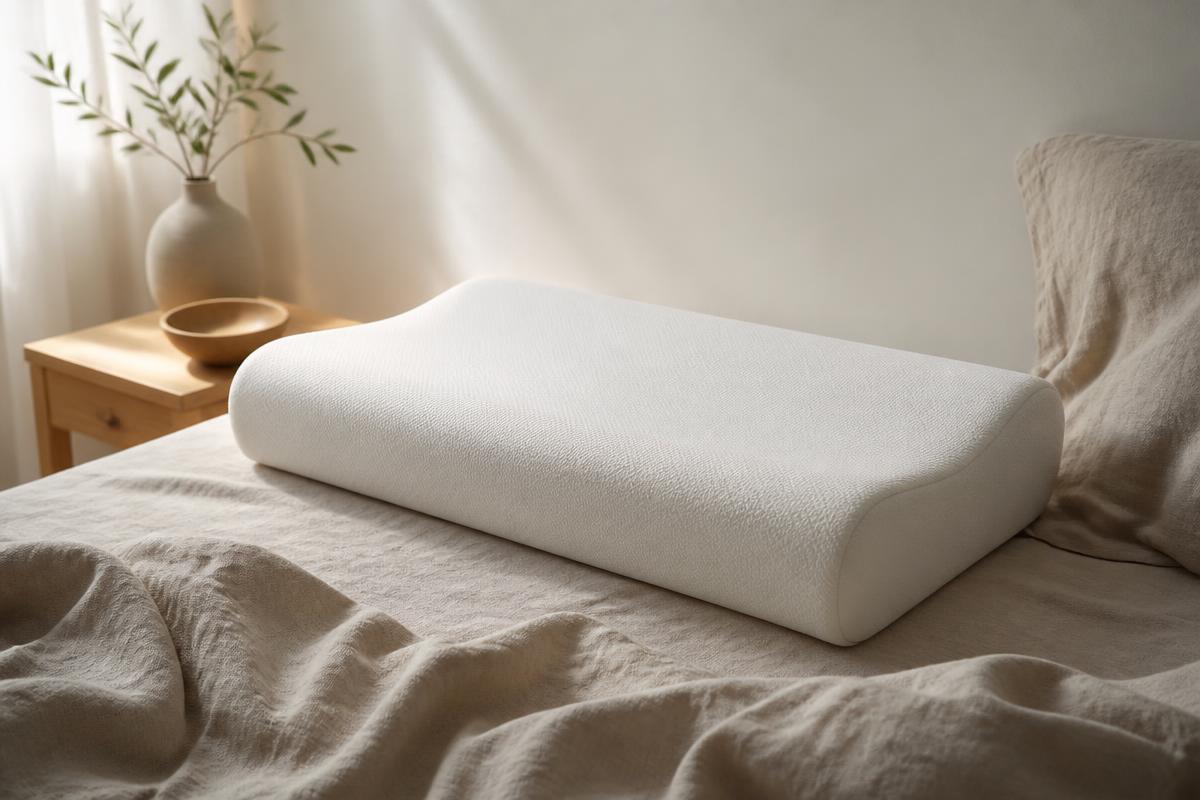
On your back, the back of your head already sits close to the mattress, so the gap to fill is the smaller curve at the neck. Medium loft is the usual starting point, and too much height here is the common error — it pushes the chin toward the chest and is often noticed as neck tightness in the morning.
Contoured pillows are frequently marketed at back sleepers, because a raised edge under the neck with a recess for the head matches the shape of the gap. Whether a fixed contour suits you depends on your proportions, so check both quoted contour heights rather than assuming the shape works by default.
Pillows for Stomach Sleepers
Face down, there is almost no gap to fill, and a normal pillow forces the head upward and holds the neck rotated for hours. This is why the usual recommendation for stomach sleepers is the thinnest, softest pillow available — or none under the head at all.
Some stomach sleepers use a very flat pillow under the head plus a thin one under the hips or stomach to reduce the arch in the lower back. It is a preference rather than a rule, but it is worth knowing about because standard pillows are rarely made with this position in mind.
- Very low loft, or no head pillow.
- Soft and highly compressible rather than supportive.
- Avoid contoured shapes, which are built for the opposite gap.
Pillows for Combination Sleepers
Most people do not hold one position all night. If you start on your side and end up on your back, a pillow optimised for either extreme will be wrong for part of the night, and the useful question becomes which compromise you can live with.
Three approaches are common. Adjustable shredded fill lets you tune the loft to sit between what each position wants. A contoured pillow with two different edge heights lets you turn it over. A wide, uniformly lofted pillow lets you move across it without falling off the supported area. None of these is a perfect answer, and choosing among them is largely about which failure mode bothers you least.
What Does Not Change With Sleeping Position
A few factors matter regardless of how you sleep, and they are easy to overlook while focusing on loft.
- Cover material and whether it is removable and machine washable.
- Exact dimensions, so the pillow fits your pillowcases and bed width.
- Breathability, particularly with dense solid foam.
- Allergen considerations, if relevant to your household.
- Return window and who pays return shipping — position fit is hard to judge before sleeping on it.
A Note on Pillow Comfort Claims
Pillows are comfort products. Listings sometimes present position-specific designs as solutions to pain, snoring or other health conditions, and those are claims a product page cannot substantiate.
Choosing a pillow suited to your position is a comfort decision. Persistent pain, numbness or disrupted breathing is a matter for an appropriately qualified professional, not a purchase decision.
Matching a Pillow to Your Position
Take this with you to any product page, in this category or another.
- Identify the position you spend most of the night in
- Note whether you change position regularly
- Match loft to the gap that position leaves
- Match firmness — softer pillows sleep lower than stated
- Check pillow width if you shift or tuck an arm under
- Check both contour heights on a shaped pillow
- Prefer adjustable fill if you are a combination sleeper
- Read the return window before ordering
Frequently Asked Questions
Continue Reading
Home & Comfort · Updated September 2026
Best Ergonomic Pillows: What Should You Look For?
We break down the key factors worth comparing before choosing an ergonomic pillow — including shape, materials, sleeping position, support and overall value.

11 min read
Read GuideHome & Comfort · Updated September 2026
Memory Foam Pillows: What to Know Before Buying
Foam pillows are described in broadly similar language but behave very differently in practice. Here is what the specifications actually tell you.
8 min read
Read Article
Home & Comfort · Updated September 2026
How to Choose the Right Pillow Height
Loft is the specification most often ignored and the one most likely to make a well-reviewed pillow feel wrong for you.
7 min read
Read ArticleAbout Clever Cart Guide
Clever Cart Guide creates independent buying guides designed to help consumers compare products, understand product features and make more informed purchasing decisions. We are not the manufacturer or seller of any product mentioned on this page.